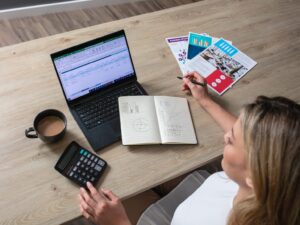

Starting out as self-employed is exciting, but it can also feel a bit daunting. I see it all the time. You’ve got the idea, maybe even your first client lined up, but you’re not quite sure what needs doing first and what can wait.
So let’s slow it down and break it all into something manageable. This guide is aimed at people starting out as sole traders, covering what you need to do, what to think about early on, and how to make sure your finances don’t catch you out.
1. Are you actually self-employed?
You’re usually classed as self-employed if you:
- work for yourself
- invoice clients for your services or sell goods
- take responsibility for making a profit (or loss)
This applies whether you’re doing it full-time or alongside employment. Plenty of people start their business as a side project — and that’s absolutely fine — but once you’re trading, there are certain things HMRC expects you to do.
2. Why most people start as a sole trader
When you’re just getting going, being a sole trader is often the simplest option. There’s less admin, fewer filings, and it’s easier to understand than jumping straight into running a limited company.
As a sole trader:
- you and the business are legally the same
- you keep the profits after tax
- you’re responsible for paying Income Tax and National Insurance
- your personal finances and business finances are linked
It’s not a forever decision — but it’s a sensible starting point for many new business owners.
3. Registering with HMRC
Once you start trading, you’ll need to register with HMRC as self-employed and sign up for Self Assessment.
You must register if your self-employed income goes over £1,000 in a tax year, and you need to do this by 5 October following the end of the tax year in which you started trading.
Registering gets you:
- a Unique Taxpayer Reference (UTR)
- access to your online tax account
- the ability to file your tax return
It’s free and done online — but getting it sorted early saves a lot of stress later on.
4. Planning your business properly (before you dive in)
This is the bit I wish more people spent time on.
Starting a business isn’t just about having a good idea — it’s about understanding whether it can realistically support you. That means thinking about:
- who your customers are
- what you’ll charge
- what your costs will be
- how long it might take before income becomes steady
I’ve written in more detail about this in [Planning a Business Launch in 2021], and despite that it was written in 2021, the principles still apply today. It’s well worth a read if you’re at the thinking or early setup stage.
5. The importance of a survival budget
When you’re employed, you generally know exactly what’s coming into your bank account each month. Running your own business removes that certainty — which is why having a survival budget is so important, especially when you’re starting out. A survival budget helps you understand how much income your household needs to survive and, in turn, what your business needs to generate to support that. This toolkit is designed to help you track all household income, essential bills, and irregular costs, plus create a safety buffer for emergencies, even if it’s small at first. If you’re not sure how much your business needs to make, this budget will answer that question and give you a clearer picture of what’s needed to keep things running smoothly.
👉 Download the Guida Accountancy Survival Budget Toolkit
(If you want to understand why this matters so much, I go deeper into it in [Why You Need a Survival Budget].)
6. Business expenses: what can you actually claim?
One of the most common questions I’m asked is:
“What can I claim as a self-employed business?”
As a sole trader, you only pay tax on your profits, not your total income. That means legitimate business expenses reduce your tax bill — but only if you know what counts.
Common expenses for new sole traders include:
- software and subscriptions
- website and domain costs
- phone and internet
- marketing and advertising
- insurance
- professional fees
I’ve put together a clear, practical guide (and downloadable resource) covering this in more detail here:
👉 What Can I Claim as a Self-Employed Business?
It’s a useful one to bookmark, especially in your first year.
7. Record-keeping (and how it fits with budgeting)
Record-keeping and budgeting often get mixed up — but they serve different purposes.
- Your survival budget helps you plan what needs to happen.
- Record-keeping tracks what has happened.
Good record-keeping means:
- your tax return is easier to complete
- you’re less likely to miss allowable expenses
- you’re prepared if HMRC ever asks questions
You don’t need a complicated system straight away, but you do need consistency. Keeping on top of things little and often is far better than trying to reconstruct a year’s worth of activity in one go.
8. Common mistakes I see new sole traders make
A few things to watch out for early on:
- not setting money aside for tax
- underestimating business costs
- mixing personal and business spending without tracking it
- assuming income will be regular straight away
- putting off planning because “it’s early days”
None of these are unusual — but they’re all much easier to avoid with the right setup.
Final thoughts
Getting started as self-employed doesn’t need to be complicated, but it does need thought. Registering properly, planning your income, understanding expenses, and keeping good records all make a huge difference — especially in that first year.
If you’re starting out and want to make sure you’re setting things up the right way, book a call with me. I’ll help you get clear on what applies to you and take the pressure off the numbers side of things.
7 numbers every business owner should know – and learn to love!
I have a guide to the 7 numbers every business owner should know – and learn to love!
You can download it here.